
When Stone Becomes the Furniture
Exploring the versatility of semi-precious stones in luxury interior projects
Natural materials often behave in unexpected ways once they leave the quarry and enter an interior. Semi-precious stones are particularly interesting in this regard. They carry colour, depth and movement that manufactured materials simply cannot replicate. When used thoughtfully, they allow furniture to become more than functional — the material itself becomes the focal point.

Across a newly refurbished townhouse in Gurugram as our latest residential project, we explored the use of three semi-precious stones within custom furniture pieces: labradorite, blue tiger’s eye, and selenite. Each material behaves very differently, which naturally led to very different design responses.
Rather than forcing the stone to follow a preconceived idea, the furniture evolved around what the material could do best.
Labradorite: A Surface That Moves With Light
Labradorite is one of those stones that constantly surprise you. At first glance it appears quite dark and understated, but the moment light hits it from a different angle, flashes of blue, green and gold begin to appear across the surface.

We used labradorite in a custom coffee table designed for a living room. Instead of keeping the form rigid, the piece was conceived with a flowing curved profile — almost like a gentle wave running through the table. This allowed the stone to wrap across the surface and down the sculptural form, emphasising the shifting pattern within the material.

Because labradorite reacts so strongly to light, the table never quite looks the same twice. During the day it appears deep and reflective, while in the evening the stone reveals subtle flashes of colour that catch the eye as you move around the room.
Blue Tiger’s Eye: A Bar Surface With Depth
The bar area in a home often allows for a slightly more dramatic material palette. It’s a place where textures, finishes and lighting can come together to create a sense of atmosphere.

For this project, we used blue tiger’s eye as the countertop surface. Unlike the warmer golden tiger’s eye that most people recognise, the blue variety has a cooler tone and a silky, almost metallic sheen. Its layered structure creates subtle linear movement within the stone, which becomes more visible as light moves across it.

Set against darker cabinetry and brass details, the stone adds depth without feeling overly decorative. It becomes the visual anchor of the bar — a material that draws you in without needing to shout for attention.

Selenite: A Table That Almost Glows
Selenite behaves very differently from most stones. Instead of being opaque, it has a soft translucency that allows light to pass through the crystal structure. The result is a surface that feels luminous rather than reflective.

For the dining table shown here, the selenite crystals were arranged in a radial starburst pattern, creating a quiet sense of symmetry across the tabletop. The material catches and diffuses light in a way that feels gentle and almost atmospheric.
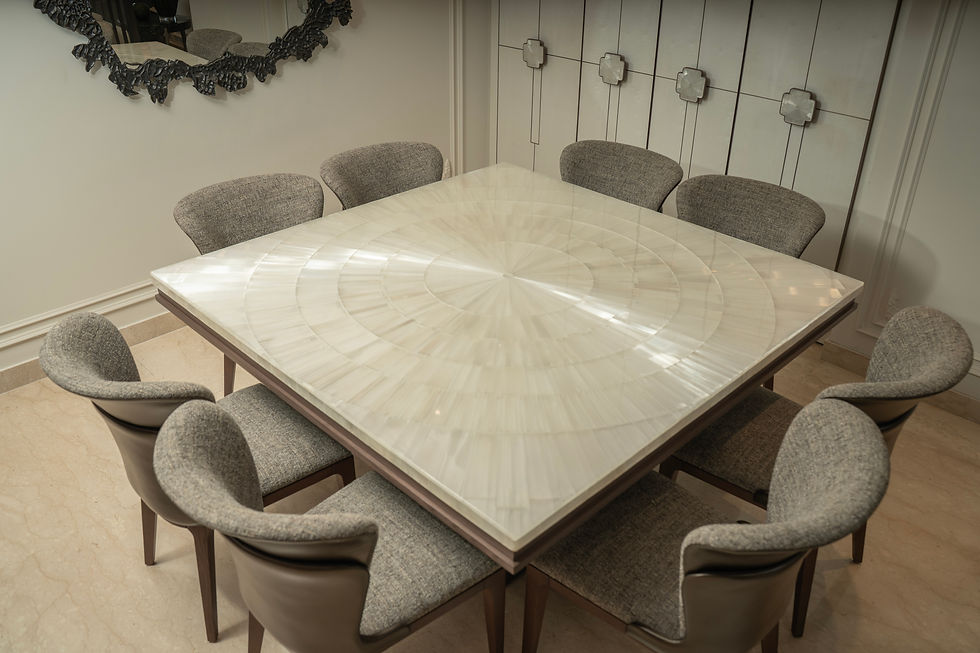
In a dining space — where the table naturally becomes the centre of the room — this kind of material adds a layer of interest without overwhelming the space. It’s detailed enough to draw attention, yet subtle enough to remain elegant.
Letting the Material Lead
Working with semi-precious stone is always a slightly unpredictable process. No two slabs are identical, and the variations in colour, pattern and translucency mean that each piece has its own character.
What surprised us most is that unpredictability is part of the appeal.
When incorporated into bespoke furniture, these stones allow the material itself to guide the design. The result is furniture that feels deeply personal to the space it inhabits — pieces that are as much about craftsmanship as they are about the natural beauty of the material.


Comments